
Your weight stays the same, but your trousers feel tighter. Your body fat scale shows less muscle even though you exercise regularly. Or your BMI is in the normal range, while your blood pressure and blood glucose results are abnormal. Situations like these raise a reasonable question: which number can you trust?
BMI, waist circumference and body fat percentage describe different aspects of the body. They become meaningful when interpreted together with symptoms, physical performance and medical findings. [7]
What BMI measures — and what it misses
Body mass index relates body weight to height: BMI = weight in kilograms / height in metres squared. For example, a weight of 80 kg and a height of 1.75 m give a BMI of 26.1 kg/m². The following categories are commonly used for adults: [1, 2]
| BMI in kg/m² | Weight category |
|---|---|
| Below 18.5 | Underweight |
| 18.5 to below 25 | Normal weight |
| 25 to below 30 | Overweight |
| 30 to below 35 | Obesity class I |
| 35 to below 40 | Obesity class II |
| 40 or above | Obesity class III |
However, BMI does not distinguish between fat, muscle and other components of the body. It also does not describe where fat is stored. People of the same height and weight therefore have the same BMI, but their body composition can differ considerably. [1, 7]
The table provides guidance for adults. Children, pregnancy, high muscle mass, frailty and fluid retention require a separate assessment. Ethnic background can also affect the assessment of metabolic risk. [1, 7]
Why fat distribution matters
Subcutaneous fat lies directly beneath the skin. Visceral fat is found deeper in the abdomen, around the internal organs. Increased visceral fat is closely associated with insulin resistance and adverse metabolic changes. The release of fatty acids and pro-inflammatory signalling molecules may play a role, among other factors. [3]
Waist circumference complements BMI as an indicator of central fat accumulation. It does not measure visceral fat directly: subcutaneous fat and other structures also contribute to the circumference. A larger abdomen alone therefore proves neither a particular amount of fat nor a metabolic disorder. [3]
How to measure your waist correctly
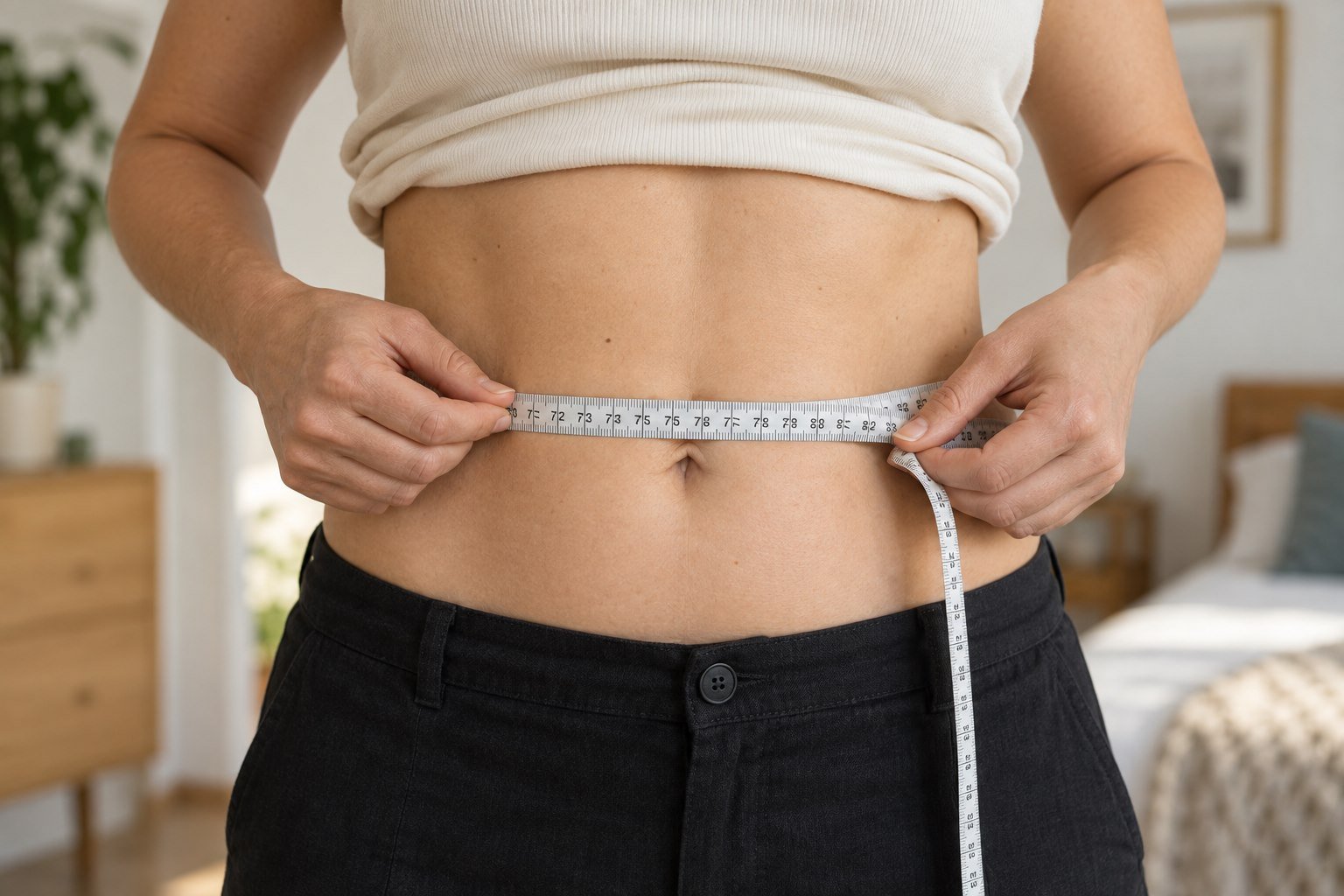
For medical comparisons, abdominal circumference usually means waist circumference. The key is to use the same measurement site consistently. A common method follows the WHO measurement protocol: [8]
- Stand upright and relax your abdomen.
- Identify the midpoint between the lowest rib you can feel and the top of the iliac crest, the upper edge of the hip bone.
- Place a non-stretch tape horizontally around your bare abdomen at that point. It should fit snugly without pressing into the skin.
- Take the reading after breathing out normally, without drawing in your abdomen or holding your breath.
- Record the measurement and use the same site for future comparisons.
Other measurement sites can produce different results. Only compare values obtained using the same method. [3]
At what circumference should you take a closer look?
The German S3 guideline gives 88 cm for women and 102 cm for men as commonly used thresholds for pronounced central fat distribution. These values are not a sharp dividing line between health and disease. Relevant risks can also exist below them; height, ethnic background, age and other findings affect the assessment. [2]
It is therefore more helpful to view an unusual circumference as a reason for medical assessment than to diagnose yourself based on a few centimetres.
Waist size in relation to height
Another guide is the waist-to-height ratio (WHtR). This is calculated by dividing waist circumference by height, using the same unit for both. The British National Health Service (NHS) uses a waist measuring less than half your height as a simple guide. A ratio of around 0.5 or above may be a reason to assess central fat distribution more closely. [4]
For example, a 90 cm waist divided by a height of 180 cm gives 0.50. The same waist circumference at a height of 160 cm gives approximately 0.56. The identical measurement in centimetres therefore represents a different proportion of height.
This guide is intended particularly for adults with a BMI below 35. It is not suitable for self-diagnosis or for assessment during pregnancy. People with eating disorders should avoid these self-measurements and discuss any questions with a healthcare professional. [4]
Body fat percentage: more information, but not an overall verdict
Body fat percentage describes the proportion of body weight made up of fat mass. In a purely mathematical example, 20 kg of fat mass at a body weight of 80 kg equals 25 per cent. This figure initially tells us nothing about how the fat is distributed.
Percentages also need context: if the 20 kg of fat mass stays unchanged while total body weight falls to 78 kg, the calculated fat percentage rises to around 25.6 per cent. This would not demonstrate an increase in fat. Conversely, a falling percentage alone does not show how much fat has actually been lost.
When interpreting results, it is therefore useful to distinguish between fat mass in kilograms, fat percentage and fat-free mass. Fat-free mass is not the same as muscle mass: it also includes water, organs and bones. A change in this overall measure must not automatically be described as muscle gain or muscle loss.
A single “ideal” body fat percentage for all adults would be misleading. The measurement method, age, sex, physical function and the specific medical question all affect interpretation. When BMI and an examination do not provide a clear picture, a targeted analysis of body composition may be a useful addition. [6, 7]

How reliable are body fat scales?
Many devices use bioelectrical impedance analysis, or BIA. They assess electrical properties of the body and use calculation models to estimate its composition. Fat or muscle mass is not measured directly. Hydration, the device and the calculation model influence the results. [6]
A 2021 study illustrates how large the differences can be: three commercially available scales were compared with DXA, an X-ray method for determining body composition. Depending on the scale, the median difference in weight was between 0 and 0.3 kg. However, the devices underestimated fat mass by a median of around 2.2 to 4.4 kg. Between 48 and 53 people were assessed, depending on the device. [5]
This small cross-sectional study cannot establish how every current device performs. It does, however, show why a precise-looking display does not automatically mean a precise body composition assessment. The study also does not demonstrate that the same scales reliably detect changes over time. [5]
For comparisons, keep the device and measurement conditions as consistent as possible. Individual fluctuations in an app do not justify a fundamental dietary change. A reported fall in “muscle mass” is not proof of muscle loss without further findings. [5]
Muscle health also shows in function
In a medical assessment of muscle health, strength is particularly important alongside muscle quantity. The European consensus on sarcopenia places reduced muscle strength at the start of the assessment. A diagnosis is confirmed through further examinations of muscle quantity or quality. A body fat scale alone is not sufficient. [6]
If climbing stairs, standing up or carrying your usual loads becomes increasingly difficult, this is a useful reason to seek a discussion, even if your weight has not changed. The cause should be assessed medically rather than simply following the percentage displayed by the scale.
Does everyone need a BIA or DXA measurement?
An additional examination should answer a specific question. EASO identifies assessment using DXA or BIA as a possible addition, particularly when findings are unclear. Whether it is useful depends on the additional value the result offers for treatment. [7]
Which findings complete the picture?
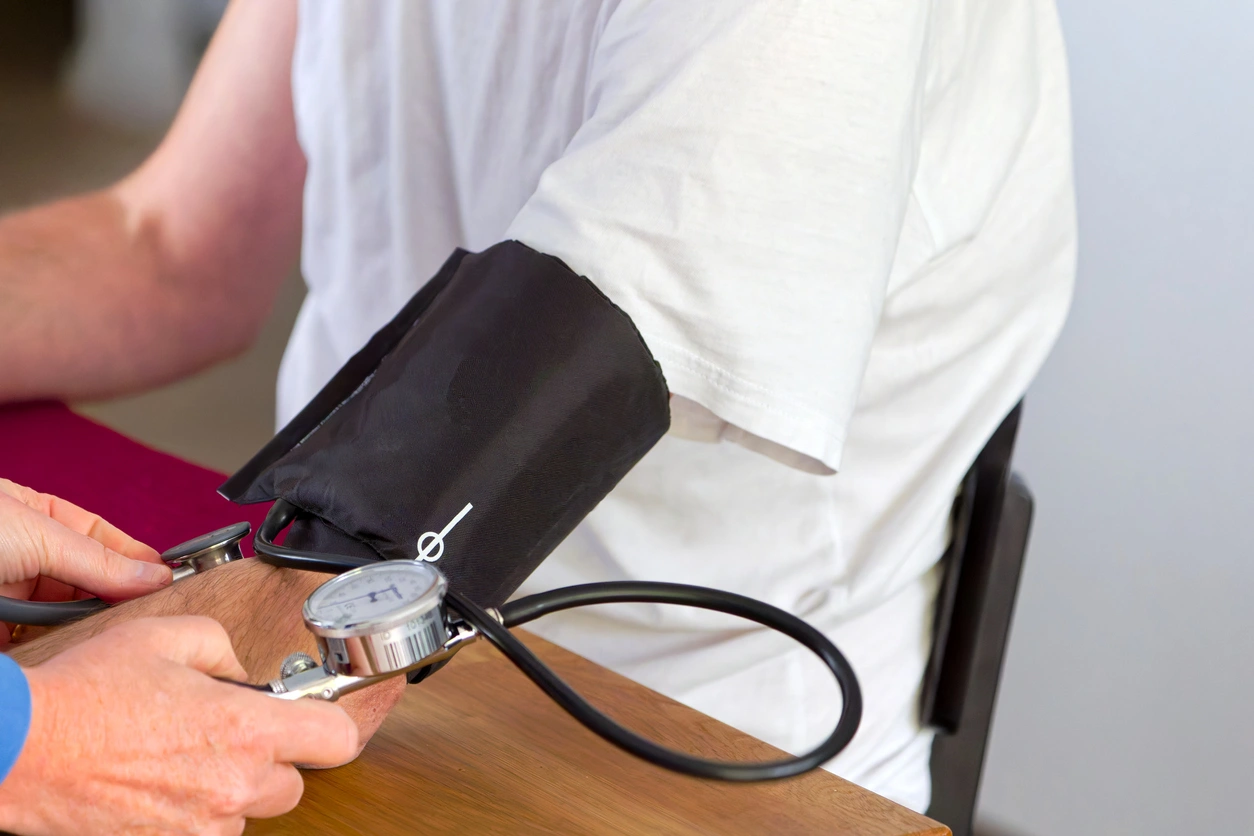
To assess metabolic and cardiovascular risk, body measurements are considered alongside other information. This includes blood pressure, glucose metabolism, blood lipids, pre-existing conditions, medicines and family history. The examinations required depend on the initial situation and the findings already available. [2]
A normal weight does not replace this assessment. Equally, an elevated BMI alone cannot tell you whether a particular associated condition is already present. If your blood glucose results are abnormal, our article Elevated HbA1c, normal fasting glucose: Which value matters? explains the different information these measurements provide.
Useful tracking starts with comparable measurements
For everyday use, a clear record is more helpful than as many numbers as possible. Record the date, the device used, your weight and, if appropriate, waist circumference. Note any particular circumstances, such as a different measurement site or changed measurement conditions. Keep body fat readings from different devices separate.
When reviewing your results, ask: can the change be reproduced across several measurements? Do circumference, weight and physical performance fit together? What trend is emerging in any previously abnormal medical findings? A smaller waist can indicate a favourable development even if weight falls only slightly. However, circumference alone does not prove a particular change in fat around the organs. [3]
If it is mainly the number on the scales that has stopped changing, you can find further guidance in our article Why weight stagnates despite dietary changes.
Have your measurements assessed by a doctor
At Bodywise in Heidelberg-Neuenheim, medical weight management includes a medical history, a physical examination and the interpretation of relevant measurements. Dr Michael Pees discusses your weight history, previous approaches, medicines and existing findings with you. If the focus is on blood pressure, laboratory results or family risks, preventive medicine provides the relevant starting point.
Existing laboratory reports and medical letters, a current medication list, and your questions and previous measurements are helpful for the appointment. Additional diagnostic tests are planned according to the medical question.

Further reading: Preventive healthcare: Which examinations may be useful?
This article provides general guidance for adults. It does not replace an individual examination and diagnosis.
Medical sources and further information
Research current as of 21 September 2026. The numbered references in the article are clickable. Guidelines and consensus papers are identified as such; the study of scales is a single cross-sectional study.
- WHO: Obesity and overweight.
Definitions of BMI, overweight and obesity in adults.
- German Obesity Society: S3 guideline on the prevention and treatment of obesity.
Version 5.0, October 2024; AWMF 050-001. In particular, Chapter 3 on diagnosis and risk assessment. In German.
- Ross R et al. (2020): Waist circumference as a vital sign in clinical practice.
IAS/ICCR consensus statement. Nature Reviews Endocrinology. 16:177–189. DOI: 10.1038/s41574-019-0310-7.
- NHS: Calculate your waist to height ratio.
Public health information; last reviewed on 25 February 2025. Use and limitations of the waist-to-height ratio.
- Frija-Masson J et al. (2021): Accuracy of Smart Scales on Weight and Body Composition.
Cross-sectional study of three consumer scales. JMIR Mhealth Uhealth. 9(4):e22487. DOI: 10.2196/22487.
- Cruz-Jentoft AJ et al. (2019): Sarcopenia: revised European consensus on definition and diagnosis.
EWGSOP2 consensus. Age and Ageing. 48(1):16–31. DOI: 10.1093/ageing/afy169. Muscle strength and the limitations of BIA and DXA.
- Busetto L et al. (2024): A new framework for the diagnosis, staging and management of obesity in adults.
EASO consensus. Nature Medicine. 30:2395–2399. DOI: 10.1038/s41591-024-03095-3.
- WHO STEPS: Collecting Step 2 data: Physical Measurements.
Measurement protocol, dated 26 January 2017; Measuring Waist Circumference section, pages 3-5-10 to 3-5-11.