Excessive sweating can go far beyond what the body needs to regulate its temperature. Hyperhidrosis may be present when sweating occurs repeatedly regardless of heat or physical exertion, visibly soaks clothing or affects work, social situations and everyday life.
At Bodywise, Dr Michael Pees assesses whether the findings are consistent with focal hyperhidrosis, whether possible triggers or associated conditions should first be investigated, and whether a locally acting medical injection treatment may be suitable for the affected area. A decision is made only after taking a medical history, performing an examination and discussing the treatment and its risks.
Understanding the treatment
How excessive sweating differs from normal sweating
Sweating is essential to life. Evaporating sweat removes heat from the body and protects it from overheating. Hyperhidrosis, by contrast, refers to sweating that exceeds what is needed for temperature regulation. The key issue is not simply a particular volume of sweat, but the dysregulation of sweating and the burden it creates.
Primary focal hyperhidrosis typically involves recurring symptoms in clearly defined areas of the body, often on both sides and independently of the ambient temperature. Symptoms may have been present since adolescence or early adulthood and can substantially affect everyday life. Individual features do not, however, replace a medical diagnosis.
Medical assessment
Distinguishing primary from secondary hyperhidrosis
In primary hyperhidrosis, no underlying internal medical condition or external cause can be identified. The sweat glands are not necessarily more numerous or enlarged; rather, they are overstimulated by the autonomic nervous system.
Secondary sweating, on the other hand, may be associated with medical conditions, medication, hormonal or metabolic changes, infections or neurological causes. New-onset sweating, sweating affecting the whole body or night sweats, as well as accompanying symptoms such as fever, unexplained weight loss, a racing heart or a marked reduction in physical capacity, should therefore not be treated prematurely as primary hyperhidrosis.
When a consultation may be helpful
Signs that should be assessed by a doctor
A consultation may be helpful if sweating repeatedly exceeds what would be expected and cannot be explained by heat, movement or an acutely stressful situation alone. Common reasons for making an appointment include:
visibly or repeatedly sweat-soaked clothing despite suitable clothing and usual hygiene measures
focal sweating that regularly interferes with everyday life, work or social situations
sweating on both sides or symmetrically in a clearly defined area of the body
inadequate results or poor tolerance of local measures tried so far
uncertainty about whether primary hyperhidrosis or another cause is responsible
The burden on an individual cannot be judged solely by the size of sweat marks. Frequency, unpredictability and the effects on clothing, work routines, leisure activities and social situations are also part of the medical assessment.
Diagnosis
Medical history and examination are central
Diagnosis is based mainly on the medical history and clinical presentation. Dr Pees asks about the onset and course of the symptoms, patterns during the day and night, affected areas, possible triggers, existing conditions, medication and previous attempts at treatment, among other factors.
Specialised procedures such as the Minor iodine-starch test can visibly identify the boundaries of an actively sweating area; gravimetry can measure the amount of sweat under standardised conditions. These tests are not necessary for everyone. Whether additional testing or further specialist assessment is appropriate depends on the individual findings.
How treatment works
How local injection treatment can reduce sweating
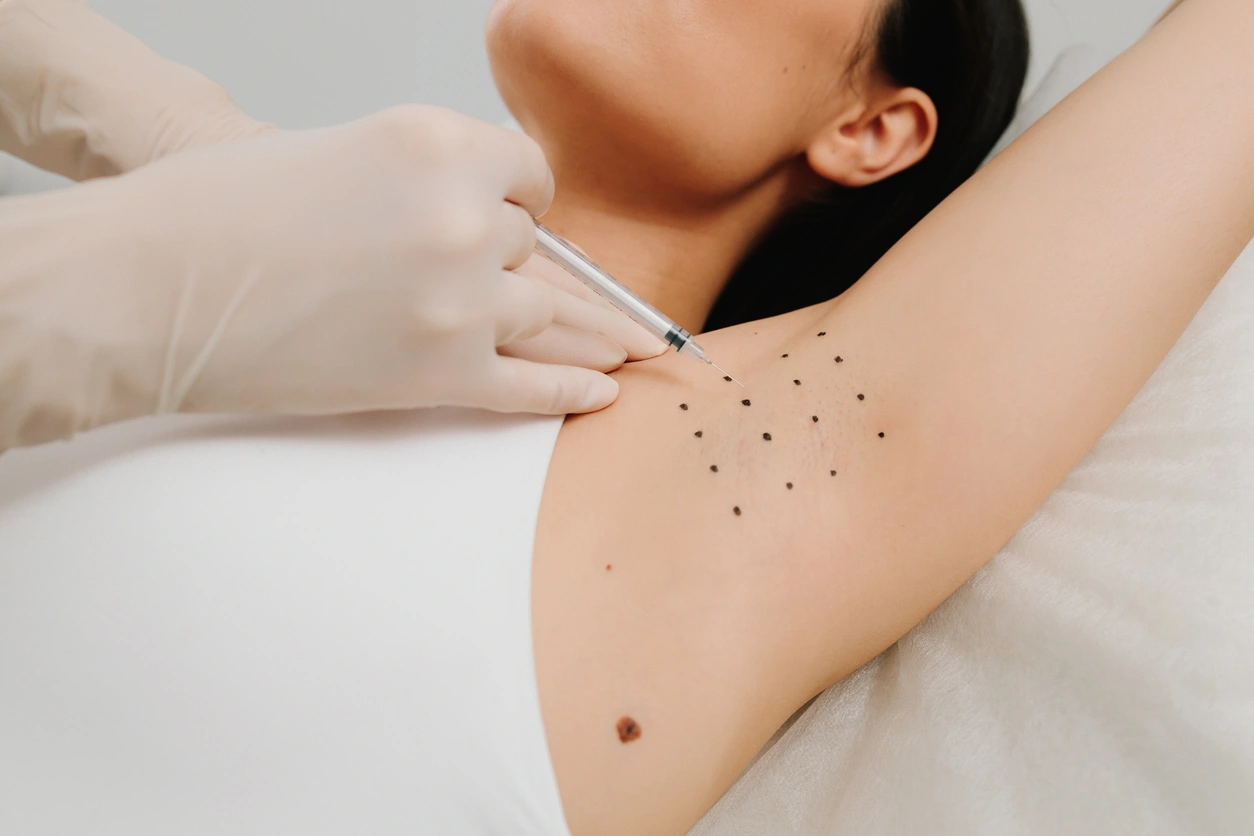
The treatment offered at Bodywise involves injecting a locally acting medicine into the previously defined area of skin. It temporarily inhibits the release of the chemical messenger acetylcholine at the nerve endings that stimulate eccrine sweat glands. This can substantially reduce sweat production in the treated area.
The sweat glands are neither removed nor permanently destroyed. The effect is reversible and limited to the treated area. Sweating in other areas of the body remains possible. The appropriate dose and distribution depend on the body area, its extent, the severity of sweating and individual circumstances.
The aim is a noticeable reduction in excessive sweating. Completely dry skin cannot be guaranteed and is not medically necessary in every case. Some sweating may remain even when the response is good.
Body area and approved use
Why the affected area must be agreed in advance
The underarm area has been studied most extensively for this type of treatment. Certain medicines are approved for use in this area. Other body areas differ in terms of skin characteristics, nerve and muscle structures, sensitivity to pain, dosage and possible risks.
Different medical and regulatory requirements may apply to the hands, feet, forehead or other areas. Use outside the approved indication requires a separate justification and informed consent. Bodywise therefore explicitly agrees the intended body area before treatment and makes no general claim for all forms of sweating.
Treatment planning
Injection treatment is not always the first step
The current German guideline recommends a stepwise approach to focal hyperhidrosis. Local antiperspirants or topical medicines are often used first for underarm sweating. Injection treatment may be considered in particular when these measures are not sufficiently effective, are not tolerated or are unsuitable for other reasons.
Depending on the area and the individual circumstances, iontophoresis, systemic medication, energy-based procedures or surgery may also be discussed. These options differ considerably in their supporting evidence, the effort involved and their risks. Not all of these procedures are offered at Bodywise; they are considered as possible alternatives when relevant to the treatment decision.
Step by step
How treatment at Bodywise works
01
Your concerns and medical history
You describe when and where sweating occurs, how much it affects your everyday life and which measures have already been tried. Existing conditions, medication and possible accompanying symptoms are recorded.
02
Medical examination
Dr Pees assesses the affected body area, the skin and the course of the symptoms. He considers whether the pattern is consistent with focal hyperhidrosis or whether further assessment would be appropriate first.
03
Indication and alternatives
Together, you discuss whether local injection treatment is appropriate for the findings. Possible alternatives, limitations and whether another stage of treatment would be preferable are taken into account.
04
Informed consent and costs
Before treatment, Dr Pees explains how it works, the expected course, possible side effects, less common risks and aftercare. The body area, treatment scope and expected costs are agreed in advance.
05
Treatment
The agreed area is prepared. The medicine is then distributed evenly across the treatment area through several small intradermal injections. The number and spacing of the injections depend on the area and its extent.
06
Aftercare and progress
You receive instructions for the period after treatment and learn when an assessment is appropriate. Repeat treatment is not planned according to a fixed calendar, but only when the effect begins to wear off and after a further medical assessment.
The effect does not begin immediately after the injection. With the most extensively studied use in the underarm area, clinical improvement is often seen within the first week. A final assessment on the day of treatment is therefore not appropriate.
The effect usually lasts several months. The prescribing information for an approved use in the underarm area describes a period of approximately four to seven months. Individual results may differ. The severity of hyperhidrosis, body area, dose, extent and individual response influence the duration.
A fixed duration cannot be promised. As the effect wears off, sweat production gradually increases again. Whether and when another treatment is appropriate is decided in light of the previous course.
Realistic expectations
What treatment can and cannot achieve
The realistic treatment goal is a substantial reduction in excessive sweating in the previously agreed area. This may reduce visibly sweat-soaked clothing, frequent changes of clothes or limitations in certain situations. The degree of improvement varies between individuals.
Treatment acts locally, rather than throughout the body.
It does not resolve an underlying condition if the sweating has a secondary cause.
The effect is temporary, not permanent.
Complete freedom from symptoms cannot be guaranteed.
Odour, skin irritation or other associated problems may have additional causes and are not automatically resolved completely.
If the symptoms are not consistent with focal hyperhidrosis or expectations are incompatible with what can medically be achieved, it may be appropriate to advise against treatment or to choose another measure first.
Alternatives
Other treatment approaches that may be considered
Depending on the body area and findings, possible alternatives include locally applied antiperspirants, topical anticholinergic medicines, tap-water iontophoresis, systemic medication and selected energy-based or surgical procedures. Benefits, the effort involved and risks differ considerably.
An appropriate consultation therefore does more than compare individual procedures. It also considers the symptoms, previous measures, everyday life, occupational demands, sensitivity to pain and willingness to undergo repeated applications.
Safety
Common temporary reactions
As with any injection treatment, temporary pain, burning, redness, swelling, tenderness or small bruises may occur in the treated area. Small injection marks are also possible. In many cases, these reactions subside within a short time.
Depending on the body area, temporary changes in sensation or local weakness in neighbouring structures may be relevant. Risks are therefore explained in relation to the specific area rather than in general terms.
Symptoms that require medical assessment
More pronounced local reactions, infections, allergic reactions or an unintended spread of the medicine's effect may occur rarely. An inadequate effect or uneven reduction in sweating is also possible.
Serious side effects are rare with the approved treatment of the underarm area. Nevertheless, treatment is not without risk. The individual informed consent discussion takes into account the body area, existing conditions, medication and previous reactions.
Suitability
When treatment may be postponed or not recommended
Treatment may be postponed or declined for reasons including:
acute infections, inflammation or injuries in the intended treatment area
known hypersensitivity to the intended medicine or any of its ingredients
certain neuromuscular conditions or unexplained muscle weakness
taking medicines that may affect neuromuscular signalling
an increased tendency to bleed or blood-thinning medication where the risk must first be assessed
pregnancy or breastfeeding, as use is generally not recommended because sufficient data are lacking
new-onset generalised sweating, night sweats or other indications of a secondary cause
This list is not exhaustive. The individual medical history and the prescribing information for the specific medicine being considered are decisive.
After treatment
Aftercare and follow-up
After treatment, you receive specific instructions for the intended body area. These cover how to care for the skin during the first few hours, which physical exertion should be avoided temporarily and when you can resume using your usual skincare products.
Monitor the treated area and your general health. Local reactions should decrease over time. If you experience unusual or worsening symptoms, contact the practice or an appropriate medical service.
A follow-up assessment may be useful to evaluate the effect, investigate a difference between sides or discuss further planning. Additional treatment or an increased dose is not provided automatically, but only after a further medical review.
The stated price refers to treatment of both sides or of a single side respectively. The intended body area and treatment scope are agreed in advance. Dr Pees explains the specific costs after examination and treatment planning, before you decide whether to proceed with treatment.
Medical services are billed according to the German Scale of Medical Fees (GOÄ). Whether private health insurance or public-service medical assistance (Beihilfe) covers the costs depends on the individual policy and medical justification. Reimbursement cannot be guaranteed.
Your treating doctor
Dr Michael Pees
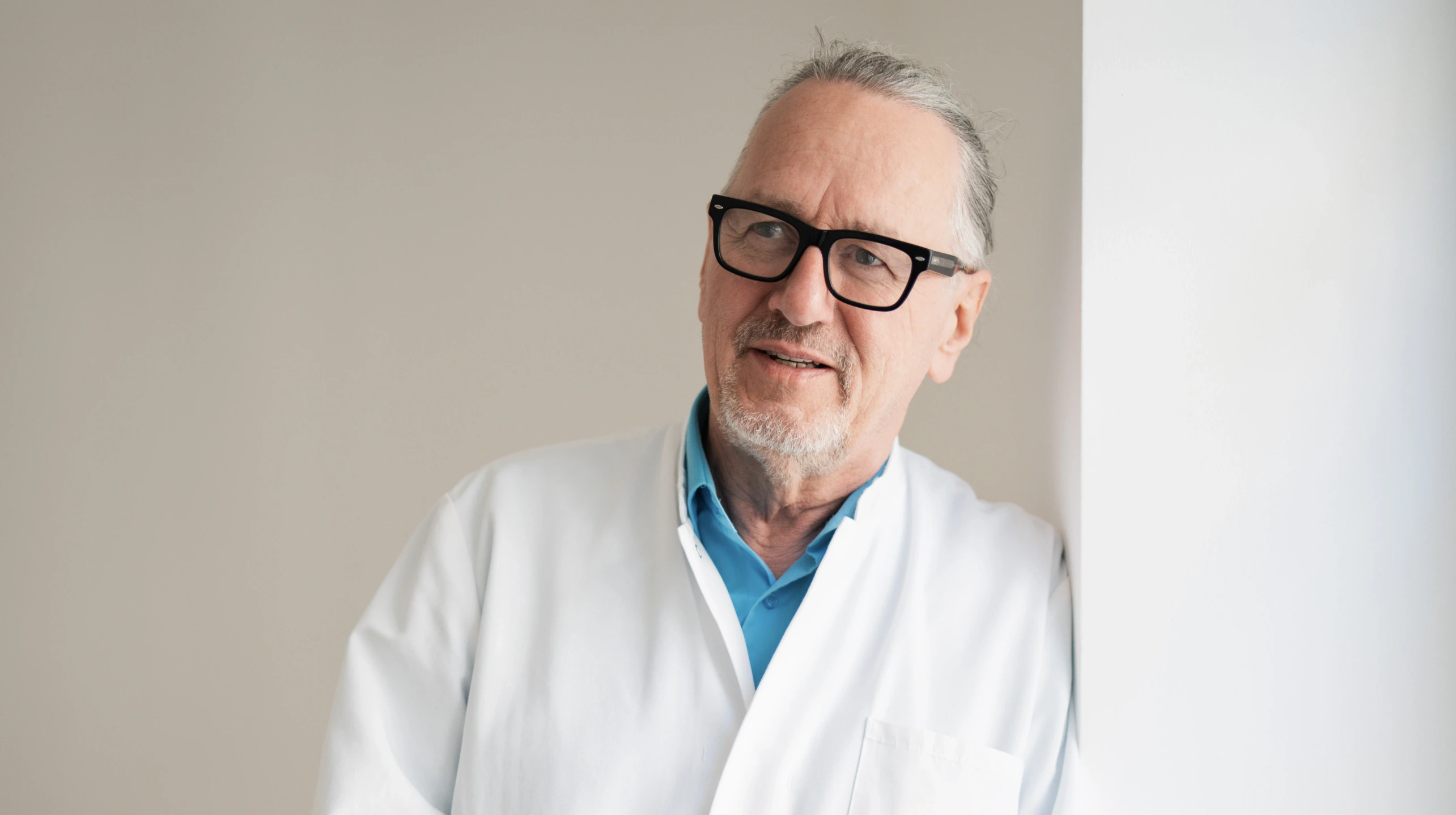
Dr Michael Pees is a specialist in surgery. For many years, he worked as a senior doctor in aesthetic surgery in Heidelberg and the surrounding region. At Bodywise, he personally provides consultation, examination, assessment of the indication, treatment and medical evaluation of progress.
For the treatment of excessive sweating, this experience is particularly relevant to taking a structured medical history, assessing the affected area, distinguishing possible causes and safely planning an injection treatment. Not every form of sweating can be appropriately addressed with a local treatment.
Hyperhidrosis is a pathological excess of sweating beyond what is needed for temperature regulation. The typical pattern and impact on everyday life are key; a single measurement is not enough to establish the diagnosis.
What is the difference between primary and secondary hyperhidrosis?
In the primary form, no underlying condition or external cause can be identified. Secondary sweating can be caused by medical conditions, medication or other medical factors. This distinction influences further treatment.
Which body areas are suitable for treatment?
At Bodywise, the intended body area is agreed in advance. The underarm area has been studied most extensively, and certain medicines are approved for use there. Other areas require a separate assessment of benefits, risks and approval status.
How does local injection treatment work?
The medicine temporarily inhibits the release of acetylcholine at the nerve endings that activate sweat glands. This can substantially reduce sweat production in the treated area.
When does the effect begin?
With treatment of the underarm area, clinical improvement is often seen within the first week. Individual results may differ; an assessment on the day of treatment is not appropriate.
How long does the effect last?
In many cases, the effect lasts several months. For an approved use in the underarm area, the prescribing information describes a period of approximately four to seven months. A fixed duration cannot be guaranteed.
What side effects can occur?
More common effects are temporary local reactions such as pain, redness, swelling, tenderness or small bruises. More severe allergic reactions or an unintended spread of the effect are rare possibilities. The risks are explained in advance in relation to the specific body area.
How much does treatment at Bodywise cost?
Bodywise publishes a price of 600 Euro for treatment of both sides or 300 Euro per side. The body area, treatment scope and expected total costs are agreed before treatment.
Patient reviews
What our patients say
Selected Google reviews about consultations and treatment at Bodywise – Dr. Michael Pees. Translated from German.
5.0/5
22 reviews
Google reviews
As of
Use the left and right arrow keys to browse reviews.
A very pleasant atmosphere in pleasant surroundings. Dr. Pees gave me knowledgeable advice that was easy to understand.
I am very satisfied with the result of my treatment. I would be very happy to recommend the practice.
raul sterk
Google review
Dr. Pees is a knowledgeable and empathetic doctor with more than 30 years of professional experience. This is also reflected positively in his thorough, open and individual advice and care. I felt very well looked after by Dr. Pees and can recommend him without reservation.
Karin P
Google review
I visited Dr. Pees again today for injectable treatments. Such a wonderful doctor; I would not go to anyone else. He deserves more than just 5 points.
Stella Stella
Google review
I can really only recommend him.
Dr. Michael Pees gave me excellent advice, and solutions to my problem were found quickly.
Have excessive sweating medically assessed in Heidelberg
Whether a local treatment is appropriate cannot be decided solely on the basis of a general description or the visible amount of sweat. At Bodywise, the first step is to establish whether the symptoms are consistent with focal hyperhidrosis, whether further assessment is needed and which stage of treatment appears medically appropriate.
If you would like an objective medical assessment, you can request a consultation or choose a general appointment online. The body area, treatment scope, possible alternatives, risks and costs are discussed transparently before a decision is made.